Frequently Asked Questions
| Acronyms | Description |
|---|---|
| AAC | Asphalt over Asphalt Concrete |
| AC | Asphalt Concrete |
| APC | Asphalt over Portland Cement Concrete |
| ASR | Alkali-Silica Reaction |
| ASTM | American Society for Testing and Materials |
| FAA | Federal Aviation Administration |
| FOD | Foreign Object Debris |
| ft | Linear Foot |
| FT | Linear Foot |
| HMA | Hot-Mix Asphalt |
| in | Inches |
| IN | Inches |
| L&T | Longitudinal and Transverse |
| lbs | Pounds |
| LBS | Pounds |
| M&R | Maintenance and Rehabilitation |
| PMP | Pavement Management Program |
| PCC | Portland Cement Concrete |
| PCI | Pavement Condition Index |
| sf | Square Foot |
| SF | Square Foot |
| SqFt | Square Foot |
| yrs | Years |
| YRS | Years |
Our application is optimized for modern web browsers. For the best performance and security, please ensure you’re using one of the following versions or newer:
| Browser | Minimum Version | Recommended |
|---|---|---|
| Google Chrome | 64+ | Latest |
| Microsoft Edge | 79+ | Latest |
| Mozilla Firefox | 67+ | Latest |
| Apple Safari | 12+ | Latest |
| Opera | 51+ | Latest |
The materials and data presented within this Client Portal are provided by TR Consulting Services LLC for informational purposes only. While every effort has been made to ensure the accuracy and reliability of the information provided, TR Consulting Services LLC assumes no responsibility for any errors, omissions, or interpretations.
The views, analyses, and results displayed within the Portal reflect the work of TR Consulting Services and its contributors, and do not necessarily represent the views or policies of any client, partner organization, or governing agency.
This Portal and its contents are provided “as is”, without warranty of any kind—express or implied—including but not limited to warranties of merchantability, fitness for a particular purpose, or non-infringement. TR Consulting Services LLC does not guarantee that the functions, data, or features of this Portal will meet user requirements or that operation will be uninterrupted or error-free.
Under no circumstances shall TR Consulting Services LLC be liable for any direct, indirect, incidental, or consequential damages, including but not limited to loss of profits, loss of data, or business interruption, arising from the use of or inability to use this Portal or the information contained herein—even if TR Consulting Services LLC has been advised of the possibility of such damages.
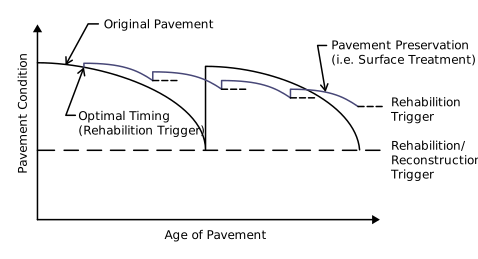
A pavement's life cycle is the relationship between its condition and age. A newly constructed pavement is considered to be in perfect condition, but as it ages, factors such as use, applied load, and climate will cause its condition value to decrease. The deterioration rate of condition vs. age is rarely linear. A properly designed pavement will typically have a lower deterioration rate through approximately 75% of its life, then at some age and condition value, the pavement's deterioration rate will increase rapidly. This point in a pavement's life is called the critical condition or critical PCI.
Finding a pavement's critical condition and performing M&R before it reaches its critical condition is the key to saving M&R dollars, as the cost to repair pavements increases dramatically beyond this point. The figure below shows a pavement's typical life cycle as related to M&R cost to repair.
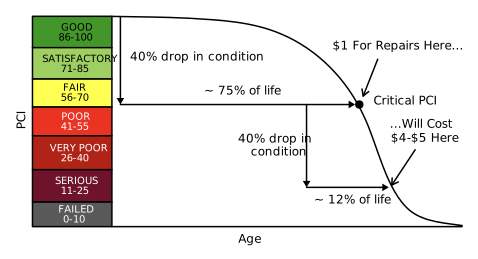
Modeling the deterioration of a single pavement's life cycle can be difficult unless there are many condition vs. age data points available. Pavements with similar characteristics such as surface type, use, and functional classification generally follow the same deterioration life cycle pattern. Within the Pavement Management System, these like pavements are grouped into families and then deterioration models are generated for each family using the numerous condition vs. age data points. Our team works closely with each client to create customized deterioration models based on the variance in their network data. These models can identify the critical condition for a specific family of pavements, and the models can be used to predict the condition of a pavement along with its appropriate M&R treatment at any future point in time.